Continuous Inkjet (CIJ) and Thermal Inkjet (TIJ) are two widely used industrial printing technologies, each…
Industrial product coding and marking require reliable printing technologies that can operate efficiently on high-speed production lines. Two of the most widely used technologies are Thermal Inkjet (TIJ) and Continuous Inkjet (CIJ) printing systems. Both solutions are designed for product identification, batch coding, barcodes, and packaging information, but they differ in operation, maintenance, and application suitability.
Understanding the differences between Thermal Inkjet vs Continuous Inkjet printers helps manufacturers choose the right solution for their production environment.
What is a Thermal Inkjet Printer?
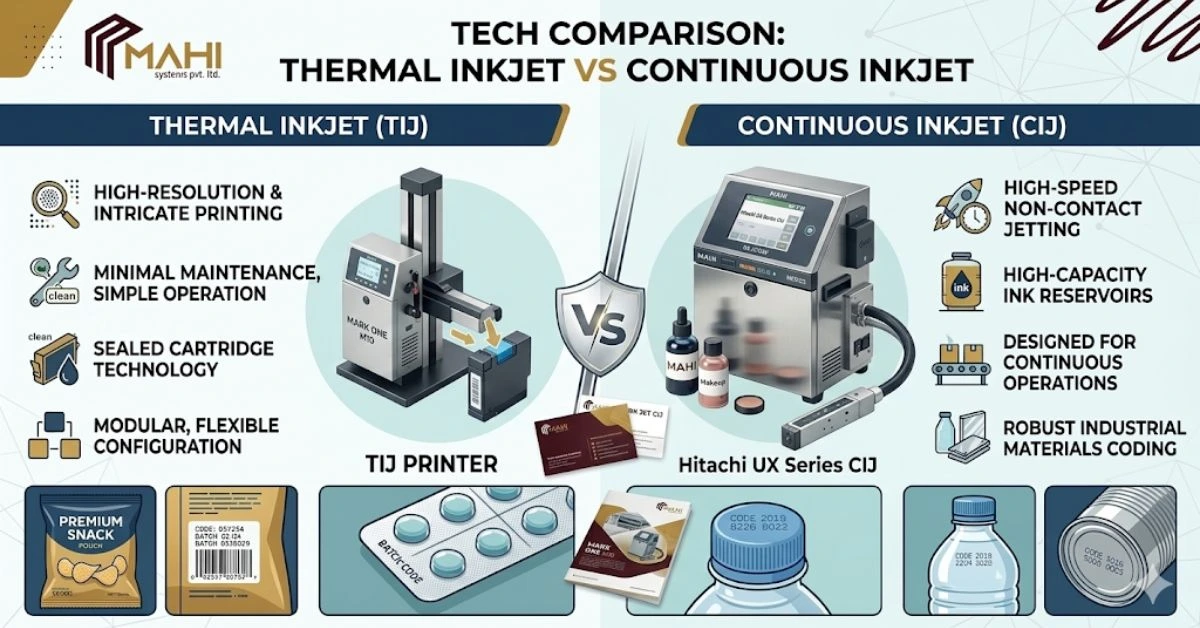
A Thermal Inkjet Printer (TIJ) uses heat to create ink droplets that are sprayed onto the product surface. Inside the print cartridge, tiny heating elements rapidly heat the ink to form bubbles, which push droplets through microscopic nozzles.
Thermal inkjet technology is widely used for:
- Carton coding
- Label printing
- Date and batch coding
- Barcode and QR code printing
- Small product packaging
Because the ink cartridge contains the print head, TIJ printers require minimal maintenance and are easy to operate.
Advantages of Thermal Inkjet Printers
- High-resolution printing quality
- Simple cartridge replacement
- Low maintenance requirements
- Compact printer design
- Ideal for clean production environments
However, TIJ printers are generally better suited for flat surfaces and slower production lines.
What is a Continuous Inkjet Printer?
A Continuous Inkjet Printer (CIJ) works differently. Instead of producing ink only when printing, it creates a continuous stream of microscopic ink droplets. Selected droplets are electrically charged and deflected onto the product surface to form characters and codes.
CIJ technology is widely used in high-speed industrial environments because it can print on a variety of surfaces, including uneven and curved products.
Typical applications include:
- Bottle coding
- Food and beverage packaging
- Pharmaceutical labeling
- Cable and wire marking
- Industrial component identification
CIJ printers are designed for continuous 24/7 operation, making them ideal for large manufacturing facilities.
Thermal Inkjet vs Continuous Inkjet: Key Differences
| Feature | Thermal Inkjet (TIJ) | Continuous Inkjet (CIJ) |
| Printing Method | Heat-based droplet formation | Continuous ink stream |
| Surface Compatibility | Mostly flat surfaces | Flat, curved, and uneven surfaces |
| Print Resolution | Very high | Medium to high |
| Speed | Moderate | Very high |
| Maintenance | Minimal | Scheduled maintenance |
| Consumables | Ink cartridges | Ink + solvent |
| Best Use | Cartons and labels | High-speed production lines |
From this comparison, it becomes clear that both technologies serve different industrial needs.
Looking for the right industrial printing solution for your production line? Contact us for expert guidance on CIJ, TIJ, and industrial coding systems.
When to Choose Thermal Inkjet Printers?
A Thermal Inkjet Printer is ideal when:
- High print resolution is required
- Printing is done on cartons or labels
- Production speeds are moderate
- Maintenance simplicity is important
- Clean environments are required
Many small and mid-scale manufacturers prefer TIJ printers because they are easy to maintain and cost-effective for packaging coding.
When to Choose Continuous Inkjet Printers?
A Continuous Inkjet Printer is the better choice when:
- Production lines run at very high speeds
- Products have curved or uneven surfaces
- Printing must occur on plastic, glass, or metal
- 24/7 production reliability is required
- Flexible ink options are needed
CIJ technology is commonly used in food, beverage, pharmaceutical, and automotive industries where large volumes require consistent coding.
Industries That Use Both Technologies
Both Thermal Inkjet and Continuous Inkjet printers are used across many industries, including:
- Food & beverage manufacturing
- Pharmaceutical production
- Cosmetics and personal care products
- Automotive parts manufacturing
- Packaging and logistics
Choosing the right system depends on production speed, surface type, and operational requirements.
Cost Comparison: TIJ vs CIJ
While TIJ printers have lower maintenance costs due to cartridge-based printing, CIJ printers often deliver better value in high-volume production environments.
Thermal Inkjet (TIJ)
- Lower initial cost
- Cartridge replacement required
- Suitable for smaller operations
Continuous Inkjet (CIJ)
- Higher initial investment
- Long-term reliability for high production
- Better for large industrial facilities
Frequently Asked Questions
Thermal Inkjet printers use heat to create ink droplets for printing, while Continuous Inkjet printers produce a continuous stream of ink droplets that are electrically charged and directed onto the product surface.
The choice depends on the application. Thermal Inkjet printers are ideal for high-resolution printing on cartons and labels, while Continuous Inkjet printers are better for high-speed industrial production lines.
Thermal Inkjet printers generally perform best on flat surfaces such as cartons, labels, and packaging materials, while Continuous Inkjet printers can print on curved or uneven surfaces.
Continuous Inkjet printers are widely used in food & beverage, pharmaceutical, automotive, electronics, and packaging industries for high-speed product coding.
Yes. Thermal Inkjet printers are low-maintenance because the print head is integrated into the cartridge, which is replaced when the ink runs out.
Conclusion
Both Thermal Inkjet and Continuous Inkjet printing technologies play important roles in modern manufacturing. TIJ printers offer high resolution and low maintenance, making them ideal for carton and label printing. CIJ printers provide unmatched speed and flexibility, allowing manufacturers to print on a wide variety of surfaces without interrupting production.
Choosing between Thermal Inkjet vs Continuous Inkjet ultimately depends on production speed, product type, and industrial environment. By evaluating these factors, manufacturers can select the right printing technology to improve efficiency, traceability, and product compliance.
Related Posts