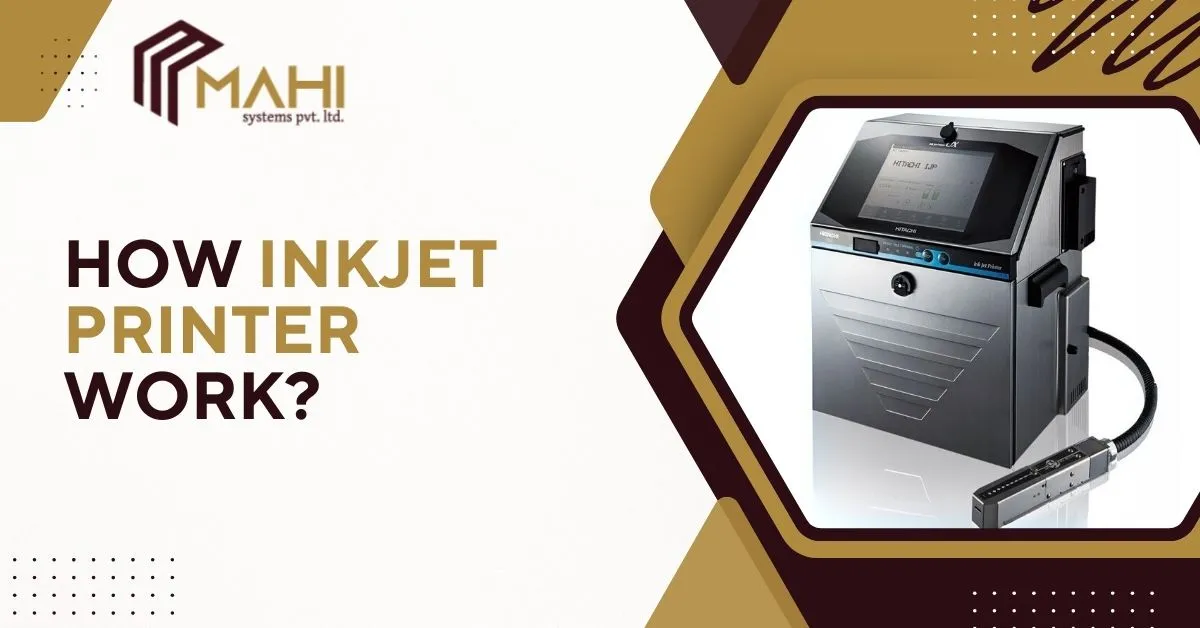
Inkjet printing is one of the most widely used printing technologies in both offices and…
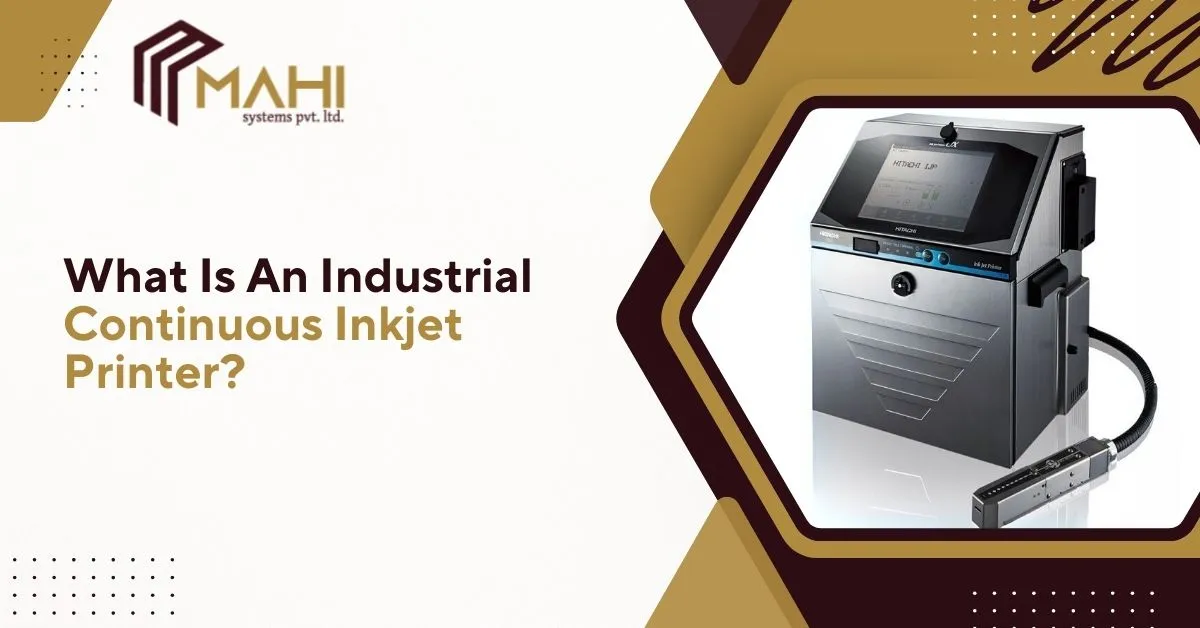
Industrial product identification is critical for traceability, compliance, and brand protection. From expiry dates to barcodes and batch codes, manufacturers rely on fast and reliable printing systems. A Continuous Inkjet Printer is one of the most trusted technologies for high-speed industrial coding and marking across production lines worldwide.
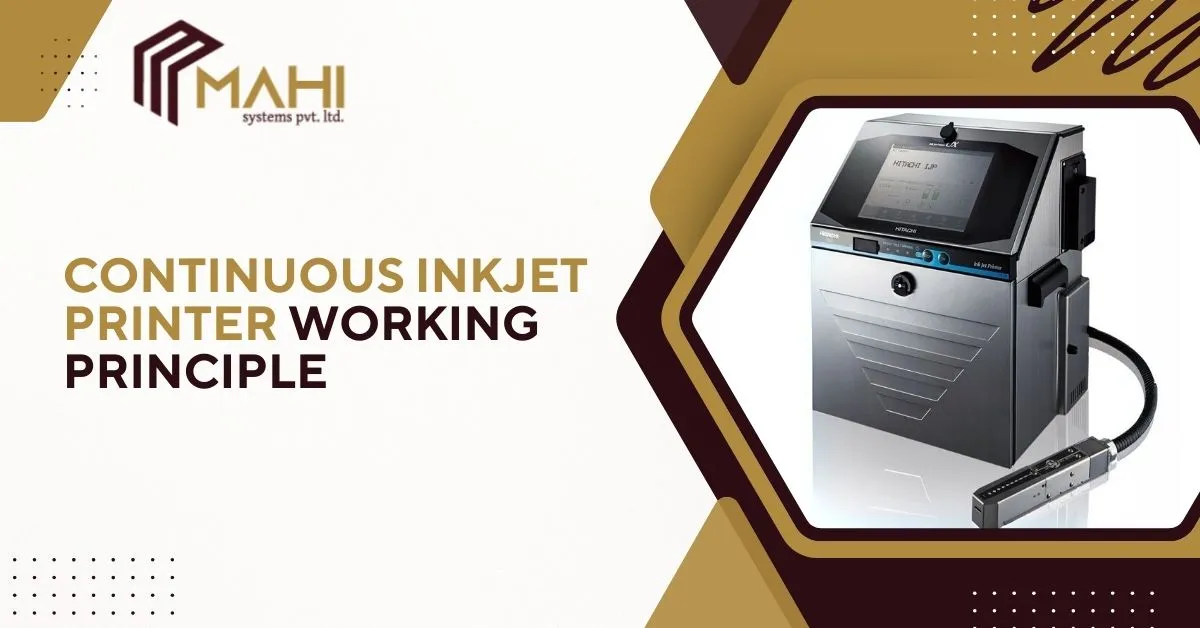
Industrial Continuous Inkjet Printer Working Principle
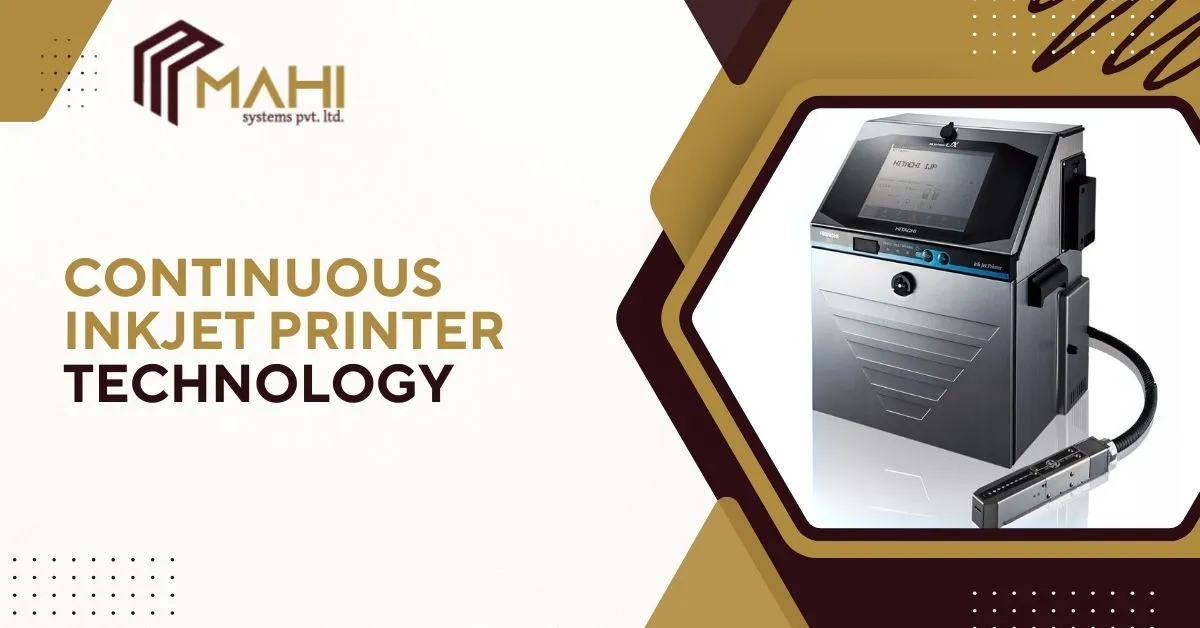
The Continuous Inkjet Printer working principle is based on creating and controlling a continuous stream of ink droplets for precise marking.
Here’s how it works:
- Ink is pressurized and pushed toward the print head.
- The nozzle creates a continuous stream of microscopic ink droplets.
- A charging electrode applies an electrical charge to selected droplets.
- Deflection plates guide charged droplets onto the product surface.
- Unused droplets are collected in a gutter and recycled back into the system.
At the center of this process, the Continuous Inkjet Printer ensures high-speed, accurate, and non-contact printing even on curved or uneven surfaces. This allows uninterrupted production and reliable performance in demanding industrial environments.
Key Components of an Industrial Continuous Inkjet Printer
An industrial Continuous Inkjet Printer consists of advanced components designed for 24/7 operation.
Core components include:
- Print head & nozzle – Creates a continuous ink jet stream for high-speed printing.
- Ink tank & recirculation unit – Maintains stable ink flow and correct viscosity.
- Charging electrode – Applies electrical charge to droplets based on the print message.
- Deflection plates – Direct droplets to form precise characters and codes.
- Gutter system – Collects unused droplets and returns ink into circulation.
- Filters & pumps – Maintain ink cleanliness and uninterrupted flow.
- Controller & software – Manages fonts, barcodes, logos, and variable data.
- Makeup/solvent system – Controls ink viscosity and drying speed.
Because of these integrated components, a Continuous Inkjet Printer can operate continuously with minimal downtime.
CIJ Printer vs Other Printing Technologies
Below is a comparison of common industrial printing technologies:
| Feature | Continuous Inkjet Printer | Thermal Inkjet (TIJ) | Laser Marking |
| Printing Method | Continuous ink stream | Cartridge-based ink | Laser beam |
| Surface Type | Curved & uneven | Mostly flat | Metal/plastic |
| Speed | Very High | Medium | High |
| Consumables | Ink + solvent | Cartridge | No ink |
| Best For | High-speed lines | Cartons/labels | Permanent engraving |
| Maintenance | Scheduled | Low | Low |
A Continuous Inkjet Printer is especially suitable for high-speed production lines and variable data printing.
Applications of Industrial Continuous Inkjet Printer
A Continuous Inkjet Printer is widely used for industrial coding and marking applications across multiple sectors because of its speed, reliability, and non-contact printing capability. It is specially designed for high-speed production lines where products move continuously and require clear, durable, and accurate coding without interrupting operations.
Common applications include
- Expiry date coding for food, beverage, and pharmaceutical products to ensure safety and compliance
- Batch number printing for production tracking and inventory management
- Manufacturing date marking for regulatory and quality control purposes
- Serial number printing for traceability and anti-counterfeiting measures
- Barcode and QR code printing for automated scanning and logistics management
- Logo and brand marking to enhance product identity and packaging visibility
- Regulatory compliance printing to meet government labeling standards
- MRP and price coding for retail packaging
- Shift code and operator identification printing for internal monitoring
- Promotional and campaign-based variable data printing
Industries that rely on Continuous Inkjet Printer systems
- Food & Beverage industry for date coding on bottles, cans, pouches, and cartons
- Pharmaceutical industry for batch, expiry, and regulatory markings
- FMCG sector for high-speed packaging line coding
- Chemical industry for marking on drums, containers, and hazardous material labels
- Automotive industry for part number and component identification
- Electronics manufacturing for PCB and component coding
- Cosmetics industry for branding and product identification
- Packaging and logistics companies for barcode and shipping label coding
Its ability to print clearly on plastic bottles, metal cans, glass containers, aluminum foils, PVC pipes, wires, cables, cartons, labels, and flexible packaging films makes the Continuous Inkjet Printer extremely versatile. It performs efficiently on curved, uneven, porous, and non-porous surfaces, ensuring consistent print quality even in demanding industrial environments.
Benefits of Industrial Continuous Inkjet Printer
The Continuous Inkjet Printer offers multiple advantages for industrial operations, especially in high-speed manufacturing and packaging environments. It is engineered to deliver consistent, reliable, and high-quality printing without interrupting production workflows. Designed for demanding factory conditions, this technology supports traceability, compliance, branding, and automation requirements across various industries.
- Non-contact printing, ideal for fragile, soft, lightweight, or heat-sensitive materials, ensuring products remain undamaged and aesthetically intact during high-speed coding processes.
- High-speed coding for fast conveyor systems, allowing accurate and legible printing even at extremely high production speeds without causing bottlenecks or delays.
- Works on curved, uneven, and difficult surfaces, including plastic bottles, aluminum cans, glass containers, PVC pipes, wires, cables, cartons, laminated pouches, and irregular packaging formats.
- Supports real-time variable data printing, such as batch numbers, lot codes, serial numbers, expiry dates, QR codes, barcodes, MRP details, shift codes, and other dynamic production information.
- Ink recirculation reduces waste, minimizing ink consumption, controlling viscosity automatically, and lowering overall operating costs while ensuring consistent print stability.
- Suitable for 24/7 continuous operations, designed for long production shifts with robust internal components and minimal manual intervention requirements.
- Easy integration with automated production lines, including compatibility with PLC systems, sensors, encoders, ERP software, and Industry 4.0 smart manufacturing setups.
- Fast-drying industrial inks that adhere strongly to plastic, metal, glass, coated paper, cartons, and flexible packaging materials, preventing smudging, fading, or rubbing during handling and transportation.
- High uptime and reduced downtime, supported by efficient ink management systems, preventive maintenance alerts, and durable hardware construction.
- Flexible ink options, including pigmented inks for dark surfaces, UV-resistant inks for outdoor exposure, washable inks for returnable bottles, and high-adhesion inks for non-porous materials.
- Scalable performance, suitable for small-scale manufacturing units, mid-sized production facilities, and large industrial plants with multiple high-speed lines.
- Cost-effective long-term operation, thanks to reduced consumable waste, controlled solvent usage, and energy-efficient system design.
- Enhanced traceability and compliance support, ensuring that products meet local and international labeling regulations with accurate and readable coding.
Because of these powerful advantages, the Continuous Inkjet Printer remains a top choice for industrial coding and packaging lines worldwide. Its ability to combine speed, accuracy, reliability, and cost-efficiency makes it an essential solution for modern production environments focused on productivity and regulatory compliance.
Keep your Continuous Inkjet Printer running at peak performance. For expert guidance and support, contact us today.
Types of Inks Used in Continuous Inkjet Printer
An industrial Continuous Inkjet Printer uses specialized inks designed for different surfaces and environments.
- Dye-based inks – Provide sharp, high-contrast printing and are commonly used for general-purpose coding on porous and semi-porous surfaces.
- Pigmented inks – Contain solid color particles that offer superior visibility on dark surfaces and improved resistance to fading, making them ideal for long-term identification.
- Fast-drying solvent inks – Designed for high-speed production lines, these inks dry quickly to prevent smudging on non-porous materials like plastic, metal, and glass.
- UV-resistant inks – Engineered to withstand sunlight and outdoor exposure, ensuring codes remain readable in harsh environmental conditions.
- Washable inks – Suitable for returnable bottles and reusable containers, these inks can be easily removed during cleaning processes.
- Food-grade inks – Formulated to meet food safety standards and regulatory compliance for direct or indirect food packaging applications.
- High-adhesion inks for plastic and metal – Specially designed to bond strongly with non-porous and smooth surfaces, ensuring durability even in challenging industrial environments.
- Chemical-resistant inks – Provide resistance against oils, solvents, and harsh industrial chemicals, ideal for automotive and chemical industries.
- Heat-resistant inks – Suitable for products exposed to high temperatures during processing or storage.
- Low-odor inks – Designed for sensitive manufacturing environments where minimal vapor emission is required.
Choosing the right ink ensures better print durability, adhesion, and regulatory compliance.
Industrial Continuous Inkjet Printer Maintenance
Proper maintenance ensures that a Continuous Inkjet Printer performs consistently over time.
- Regular nozzle cleaning – Prevents clogging and ensures consistent droplet formation for sharp and accurate printing.
- Filter replacement – Maintains ink purity by removing contaminants that could block internal components or affect print quality.
- Ink viscosity monitoring – Ensures proper ink thickness for stable jet formation, controlled droplet charging, and clear printing.
- Scheduled preventive servicing – Includes inspection of pumps, valves, ink lines, and electronic components to avoid unexpected breakdowns.
- Proper shutdown procedures – Prevents ink drying inside the system and protects internal components during idle periods.
- Gutter and return line cleaning – Keeps unused ink recirculation smooth and prevents blockages.
- Makeup solvent level checks – Maintains correct ink balance and prevents viscosity fluctuations.
- Software and firmware updates – Improves system performance, compatibility, and security.
- Routine inspection of electrical connections – Ensures stable power supply and uninterrupted printing.
With planned maintenance, CIJ systems can operate efficiently for years in demanding industrial environments.
Why Industries Choose Continuous Inkjet Printer?
Manufacturers prefer a Continuous Inkjet Printer because it offers:
- Reliable high-speed printing
- Scalability for large production facilities
- Long operational life
- Strong ROI due to reduced downtime
- Automation compatibility
- Flexible integration with conveyors
The ability to print variable information without stopping production makes CIJ technology essential for modern smart factories.
Frequently Asked Questions
An Industrial Continuous Inkjet Printer is a high-speed coding machine that prints variable data like batch codes and expiry dates using a continuous ink stream.
It creates a continuous ink stream, charges selected droplets, and directs them to form characters on product surfaces.
Continuous Inkjet Printer systems can print on plastic, glass, metal, cartons, cables, and curved surfaces.
Yes, industrial CIJ printers are designed for continuous, high-speed production environments.
Food, pharma, FMCG, automotive, chemical, electronics, and packaging industries widely use CIJ technology.
Conclusion
An Industrial Continuous Inkjet Printer is a powerful, high-speed coding solution designed for modern manufacturing. With its non-contact printing method, continuous ink recirculation, and ability to print variable data on diverse materials, it plays a critical role in industrial traceability and compliance. By understanding how a Continuous Inkjet Printer works and its key benefits, businesses can choose the right printing technology to improve productivity, reduce downtime, and ensure reliable product identification across production lines.
Related Posts