The lifespan of thermal printing depends on the type of thermal method used. With direct…
Modern printing technologies often create confusion, especially when it comes to ink usage. One of the most frequently asked questions by businesses, manufacturers, and packaging professionals is:
“Do thermal printers use ink?”
The short answer is it depends on the type of thermal printer. To make the right decision for labeling, packaging, coding, and industrial marking, it’s important to understand how Thermal Inkjet Printers, Direct Thermal Printers, and Thermal Transfer Printers actually work.
This guide explains everything clearly—how thermal printing works, when ink is required, and which technology is best for your application.
What Does “Thermal” Really Mean?
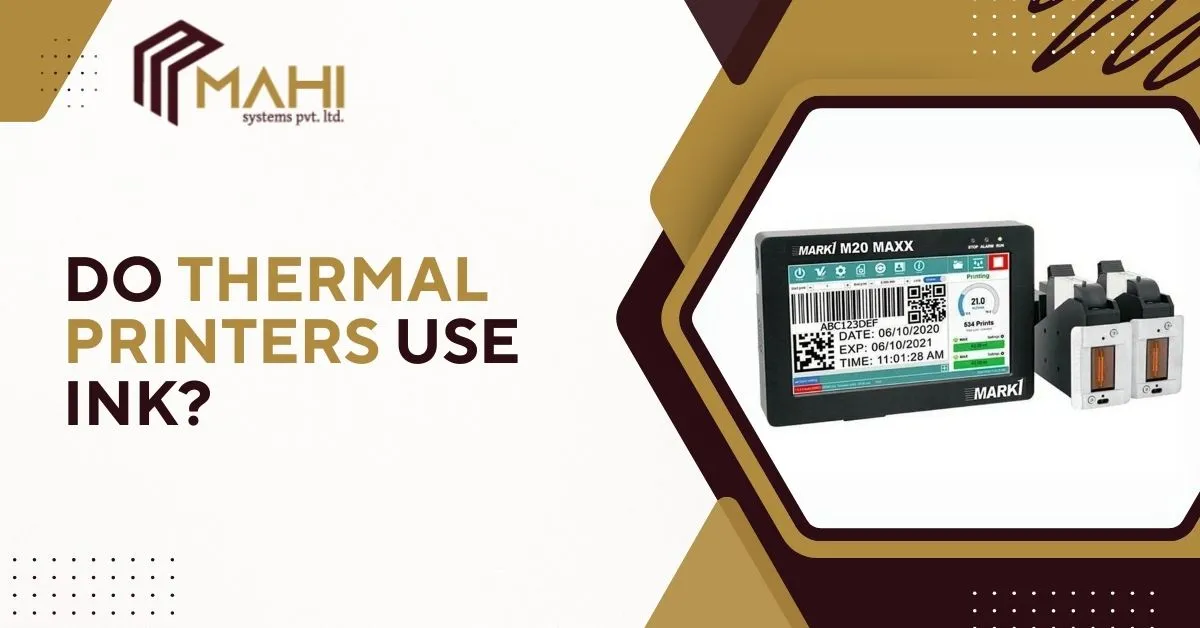
Thermal Inkjet Printers use heat as part of the printing process, but this does not always mean they work without ink. In Thermal Inkjet Printers, microscopic heating elements rapidly heat liquid ink inside the cartridge, creating tiny droplets that form text or images on the surface. This heat-based process allows precise control over droplet size and placement, resulting in sharp, high-resolution prints.
This heat-controlled ink delivery allows:
- Extremely sharp text and graphics
- High-resolution printing
- Accurate placement of droplets
- Clean, contact-free operation
So while heat is involved, Thermal Inkjet Printers still rely on ink to create the print.
Thermal Inkjet Printers vs Direct Thermal Printers
The confusion around ink usage usually comes from mixing two different technologies. Thermal Inkjet Printers use ink, while direct thermal printers do not. In direct thermal printing, heat reacts with chemically coated paper to create an image, eliminating the need for ink or toner. However, Thermal Inkjet Printers use ink combined with heat to deliver permanent, high-contrast marks on many surfaces beyond thermal paper.
Thermal Inkjet Printers
- Use liquid ink
- Heat is used to eject ink droplets
- Print on cartons, labels, films, paper, coated surfaces
- Suitable for industrial coding, packaging, and variable data
Direct Thermal Printers
- Do not use ink
- Heat reacts with chemically coated thermal paper
- Commonly used for receipts, shipping labels, tickets
- Prints can fade over time and are sensitive to heat and sunlight
Do They Use Ink?
Yes, Thermal Inkjet Printers absolutely use ink. The key difference is how the ink is applied. Instead of mechanical pressure, thermal energy pushes ink droplets onto the printing surface. This method allows cleaner operation, less mechanical wear, and high print clarity.
This method offers several benefits:
- Fewer moving parts
- Lower mechanical wear
- Cleaner operation
- Consistent print quality
- High-resolution output
Types of Thermal Printing and Ink Usage
| Printing Type | Uses Ink | Common Applications |
| Thermal Inkjet Printers | Yes | Packaging, coding, labeling |
| Direct Thermal Printers | No | Receipts, shipping labels |
| Thermal Transfer Printers | Yes (Ribbon) | Industrial labels, barcodes |
This table clearly shows that Thermal Inkjet Printers fall into the category that requires ink for printing.
Why Ink Is Still Important?
Ink plays a critical role in ensuring durability and readability. Thermal Inkjet Printers produce prints that resist smudging, fading, and abrasion when the correct ink is used. This makes them suitable for industries that require long-lasting codes, such as food packaging, pharmaceuticals, electronics, and logistics. Without ink, the flexibility and permanence offered by Thermal Inkjet Printers would not be possible.
Advantages of Thermal Inkjet Printers Using Ink
Using ink with thermal technology offers several advantages. Thermal Inkjet Printers provide high-resolution output, low maintenance, quick startup, and precise control over print quality. Since the printhead is often built into the cartridge, replacing ink also refreshes the printing mechanism.
Using ink with thermal technology offers several important advantages:
- High-resolution printing (text, barcodes, QR codes)
- Low maintenance due to fewer moving parts
- Instant startup with no warm-up time
- Precise droplet control for clean edges
- Compact design for easy integration
- Consistent performance over long production runs
This design reduces downtime and ensures consistent performance over long production runs.
Want to choose the right thermal printing solution for your business?
Contact us today for expert guidance and support.
Common Industrial Uses
Because of their accuracy and reliability, Thermal Inkjet Printers are widely used for:
- Barcode and QR code printing
- Date and batch coding
- Variable data printing
- Product branding and labeling
- Compliance and traceability marking
Their ability to print clearly on porous and semi-porous materials makes Thermal Inkjet Printers a preferred choice in many industries.
Frequently Asked Questions
Yes, Thermal Inkjet Printers use ink cartridges that are heated to create precise printed marks.
Direct thermal printers work without ink by using heat-sensitive paper.
Heat allows precise control of ink droplets for high-resolution and accurate printing.
Ink usage is efficient, and maintenance costs are generally lower compared to traditional inkjet systems.
Yes, Thermal Inkjet Printers are widely used in industrial coding, packaging, and labeling applications.
Conclusion
So, do thermal printers use ink? The answer depends on the type. Thermal Inkjet Printers do use ink, relying on heat to precisely eject ink droplets for high-quality, permanent printing. While direct thermal printers work without ink, they are limited in durability and material compatibility. For businesses needing clarity, flexibility, and professional results, Thermal Inkjet Printers remain a powerful and efficient solution
Related Posts