Industrial product coding and marking require reliable printing technologies that can operate efficiently on high-speed…
Printing Maximum Retail Price (MRP) and other variable information on product packaging is an important part of many manufacturing and packaging operations. The selected coding technology can influence print quality, production line integration, substrate compatibility, and long-term operational requirements.
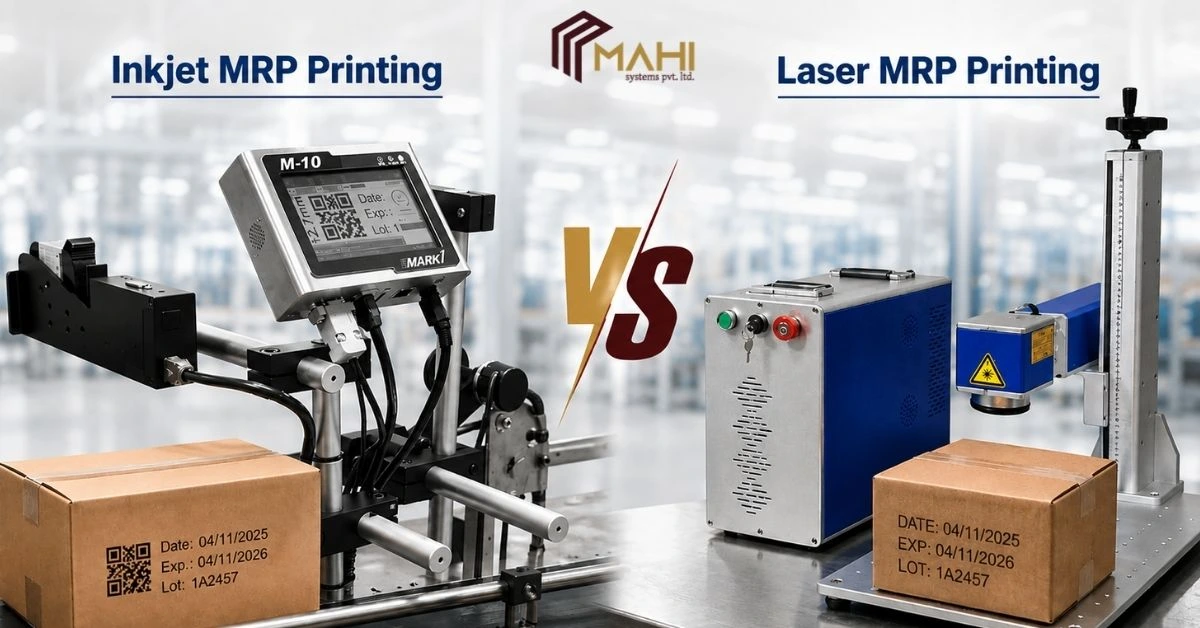
Two commonly used approaches are Inkjet MRP Printing and Laser MRP Printing. Both technologies can be used for industrial coding applications, but they operate differently and offer different advantages depending on the material, production environment, and marking requirements.
This article compares both technologies to help manufacturers understand which option may be more suitable for their packaging operations.
What Is Inkjet MRP Printing?
Industrial coding systems use ink-based, non-contact technology to print variable information directly onto products and packaging materials. In modern manufacturing operations, Inkjet MRP Printing supports the application of MRP, manufacturing dates, expiry dates, batch numbers, serial numbers, barcodes, and other variable data with suitable printer configurations.
An inkjet system is commonly selected where production lines require flexible printing across different packaging materials and surfaces. Depending on the printer configuration, Inkjet MRP Printing can be integrated into automated production lines for continuous product coding and marking.
Common Information Printed Using Inkjet Systems
- MRP and price information
- Manufacturing dates
- Expiry dates
- Batch and lot numbers
- Serial numbers
- Barcodes
- QR codes
- Variable product information
The suitability of an inkjet system depends on the substrate and the specific production requirements.
Understanding Inkjet Printer Technology
Modern Inkjet Printer Technology is designed to place ink onto a surface without direct physical contact. This makes the technology useful for coding products moving through industrial production lines.
An industrial Inkjet Printer Machine can be configured for different coding applications based on the material and type of information being printed. Inkjet printing can be used across a variety of packaging formats where clear variable data is required.
The key consideration is selecting a suitable printer and ink combination for the substrate, production speed, and operating conditions.
What Is Laser MRP Printing?
Laser technology uses a focused beam to create marks directly on the surface of products or packaging materials. In industrial coding applications, Laser MRP Printing can be used for MRP, batch numbers, serial numbers, traceability codes, and other identification information without relying on printing ink.
The process is suitable where permanent marking is required on compatible materials. Laser MRP Printing can support different production requirements depending on the material, marking parameters, and production line configuration.
Fiber laser marking machines from Mahi Systems are designed for permanent, high-contrast marking on materials including metals, plastics, and industrial-grade substrates. The available range includes on-the-fly and tabletop variants for different production requirements.
Understanding the Laser Printing Process
The Laser Printing Process creates a mark by directing laser energy onto the material surface. The resulting mark depends on the material and the laser marking parameters used.
For industrial applications, laser technology can support:
- Permanent identification marks
- Serial number coding
- Batch identification
- Traceability codes
- Product branding
- Industrial component marking
Mahi Systems fiber laser marking machines are designed for high-speed, high-precision marking applications and can be used on flat, curved, and uneven surfaces.
Inkjet vs Laser MRP Printing: Key Differences
| Factor | Inkjet MRP Printing | Laser MRP Printing |
| Marking method | Uses ink to print information | Uses laser energy to create marks |
| Contact | Non-contact printing | Non-contact marking |
| Consumables | Requires suitable ink | Does not use printing ink |
| Variable data | Suitable for variable information | Suitable for coding and identification |
| Surface compatibility | Depends on printer and ink selection | Depends on laser and material compatibility |
| Mark permanence | Depends on ink and substrate | Designed for permanent marking |
| Production integration | Suitable for automated production lines | Inline and tabletop options available |
| Maintenance requirements | Depend on the printer system | Fiber laser systems are described as low-maintenance |
Print Quality and Marking Requirements
The required appearance of the code is an important factor when comparing the two technologies.
For packaging applications requiring variable information, Inkjet MRP Printing uses ink to create codes, with results influenced by factors such as ink selection, substrate characteristics, and operating conditions.
Laser technology creates information directly on compatible material surfaces. In applications where permanent identification and high-contrast marking are required, Laser MRP Printing can provide a suitable coding approach.
The decision should therefore consider whether the application requires a printed code or a permanent laser mark.
Material and Packaging Compatibility
Packaging materials vary significantly across industries. Products may use cartons, labels, flexible pouches, plastics, metals, or other industrial substrates.
Inkjet systems can be selected for different porous and non-porous materials based on suitable ink and printer configuration.
Laser marking compatibility should be evaluated according to the material being marked. Mahi Systems fiber laser marking machines are specified for materials including metals, plastics, ceramics, and industrial-grade substrates.
Before selecting either technology, manufacturers should test the marking result on the actual product material where possible.
Production Speed and Integration
Production line requirements are another important consideration.
An industrial Inkjet Printer Machine can support continuous coding applications where products move through automated packaging lines. The printer configuration should be selected according to the required speed and coding requirements.
Mahi Systems also offers fiber laser solutions with on-the-fly variants designed for industrial production environments. This allows laser marking to be considered for applications requiring continuous product movement and inline coding.
The best option depends on the required throughput, available installation space, and production line configuration.
Looking for the right MRP printing solution? Contact Us to choose between reliable inkjet and laser coding technologies.
Maintenance and Operational Considerations
Operational requirements differ between the two technologies.
Inkjet printing systems require attention to factors associated with ink-based printing, including cartridge or ink management and suitable operation for consistent print quality.
Fiber laser systems use solid-state laser technology and are described by Mahi Systems as maintenance-free or low-maintenance solutions. Because laser marking does not use printing ink, ink consumables are not part of the marking process.
However, manufacturers should evaluate the complete operational requirements of the selected equipment rather than considering only one factor.
When Should You Choose Inkjet MRP Printing?
Applications requiring flexible variable data coding may benefit from an ink-based printing approach. In suitable industrial packaging operations, Inkjet MRP Printing can support the printing of different product information across compatible materials and formats.
It may be considered when the application requires:
- Flexible variable data printing
- Coding on different packaging formats
- MRP, date, and batch information
- Barcode and QR code printing
- Integration with automated packaging operations
- Ink-based printing on suitable substrates
The specific printer should be selected according to the packaging material and production environment.
When Should You Choose Laser MRP Printing?
Applications requiring permanent and direct product marking may benefit from laser-based coding technology. For suitable industrial materials and production setups, Laser MRP Printing can support clear identification and traceability requirements.
It may be considered when the application requires:
- Permanent product marking
- High-contrast codes
- Non-contact marking
- Traceability information
- Serial and batch identification
- Marking on compatible industrial materials
- Inline or tabletop marking options
The material characteristics and required marking results should be evaluated before choosing a laser system.
Which Technology Is Better?
There is no single answer to whether Inkjet MRP Printing or Laser MRP Printing is universally better. The right technology depends on the application.
Inkjet technology may be more appropriate for flexible variable data coding across suitable packaging materials, while laser technology can be considered for applications where permanent, direct marking on compatible materials is required.
Manufacturers should compare:
- Packaging material
- Required print or mark quality
- Production line speed
- Type of variable information
- Mark permanence requirements
- Installation requirements
- Operational considerations
A practical evaluation of the actual product and production environment can help determine the most appropriate technology.
Frequently Asked Questions
Inkjet MRP Printing uses ink to print variable information, while Laser MRP Printing uses laser energy to create marks directly on compatible material surfaces.
The better option depends on the packaging material, production speed, coding requirements, required mark permanence, and overall production setup.
Yes, industrial inkjet systems can print variable information such as MRP, manufacturing dates, expiry dates, batch numbers, serial numbers, barcodes, and QR codes.
Laser marking is designed to create permanent marks directly on compatible product or packaging surfaces, making it suitable for identification and traceability applications.
According to Mahi Systems, fiber laser marking machines are suitable for materials including metals, plastics, ceramics, and other industrial-grade substrates.
Conclusion
Both Inkjet MRP Printing and Laser MRP Printing serve important roles in industrial coding operations. Inkjet technology provides flexibility for variable data printing, while laser technology offers a different approach based on permanent, direct marking.
Understanding the differences in printing methods, material compatibility, production integration, and operational requirements can help manufacturers make a more informed technology choice. Evaluating the actual packaging material and coding objective remains essential when deciding between inkjet and laser solutions.
Related Posts