Packaging needs to communicate more than a product name. Manufacturing dates, expiry dates, batch numbers,…
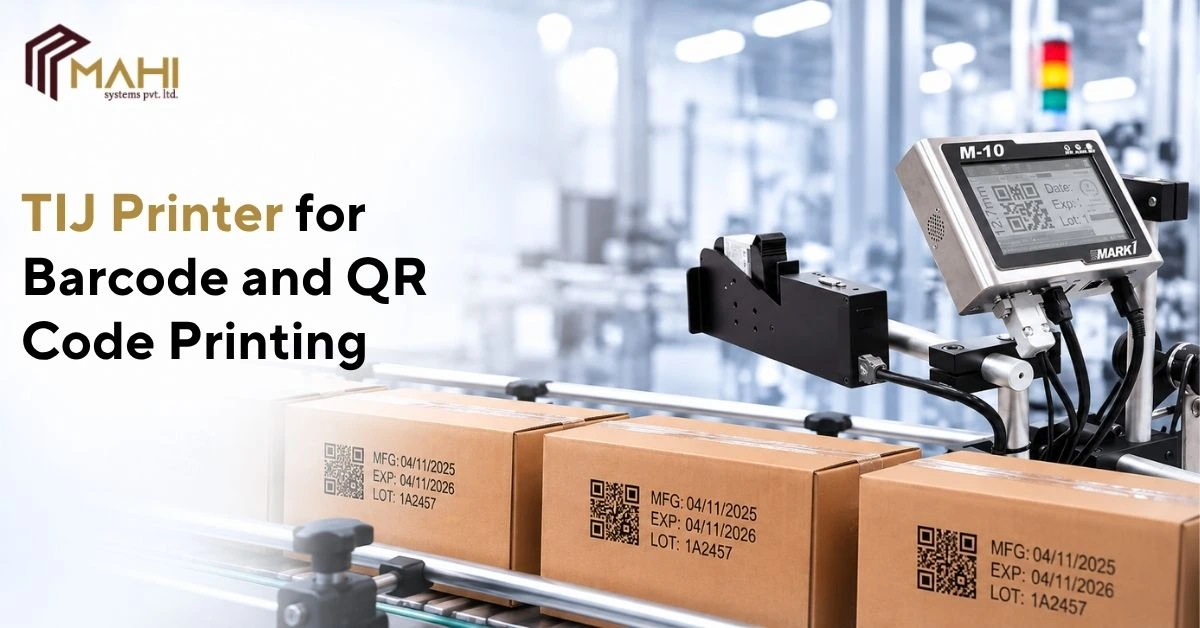
Barcodes and QR codes help manufacturers identify products, manage inventory, and share information throughout the supply chain. Printing these codes clearly is important because poor readability can affect scanning and product tracking. A TIJ Printer provides a high-resolution printing option for applying machine-readable codes to suitable packaging materials, cartons, labels, and other products.
Why Is a TIJ Printer Used for Barcode and QR Code Printing?
Barcodes and QR codes contain information that must be printed clearly enough for scanners to read. A TIJ Printer uses thermal inkjet technology to produce precise characters, making it suitable for applications that require compact codes and detailed printing.
The technology can support product identification, inventory tracking, and packaging traceability. Its suitability depends on the code dimensions, printing surface, scanning requirements, and production environment.
What Types of Codes Can a TIJ Printer Print?
Depending on the printer configuration and software, thermal inkjet systems can print different types of machine-readable information. A TIJ Printer can support applications involving:
- 1D barcodes for product identification and inventory management
- QR codes for digital information and product traceability
- 2D codes for storing structured product information
- Batch numbers and serial numbers alongside machine-readable codes
The information encoded in a barcode or QR code should match the intended application. Code size, contrast, and print quality also need to be suitable for the scanning equipment.
Which Packaging Materials Are Suitable for TIJ Printing?
Packaging materials vary in texture, absorbency, and surface finish. Cartons, corrugated packaging, labels, and certain flexible packaging materials may require different ink and printing configurations.
A TIJ Printer should be selected according to the substrate and the required print performance. Mahi Systems offers MARK ONE M10 and MARK ONE M20 thermal inkjet printer models, designed for industrial coding applications. Its TIJ range supports printing on suitable porous and non-porous materials, subject to the ink and application requirements.
Need a suitable coding solution? Contact us to discuss your barcode and QR code printing requirements.
What Affects Barcode and QR Code Readability?
A printed code must be clear, correctly positioned, and compatible with the scanner being used. Even when a TIJ Printer can produce high-resolution output, several factors influence whether a code scans reliably.
Important considerations include:
- Print resolution: Mahi Systems’ TIJ range supports printing up to 600 DPI.
- Code dimensions: The code must suit the available print area and scanner.
- Contrast: The printed code should be distinguishable from its background.
- Surface quality: The packaging material should support clear, consistent printing.
- Verification: Test printed codes with the intended scanning equipment before full production.
How Does TIJ Printing Fit into a Production Line?
Barcode and QR code printing often takes place during packaging rather than as a separate manual process. A TIJ Printer can integrate with compatible conveyor systems and production equipment, allowing codes to be applied at a defined point as products move through the line.
Before installation, manufacturers should evaluate line speed, product positioning, print location, code changes, and available integration options. Testing the setup under actual production conditions helps identify readability or positioning issues before regular operation.
Frequently Asked Questions
Yes. Compatible TIJ systems can print barcodes and QR codes when the code format, size, software, ink, and substrate are suitable for the application.
Mahi Systems’ TIJ range supports printing at resolutions of up to 600 DPI.
Yes. TIJ printers can print QR codes on suitable cartons and packaging materials, provided the ink and printing configuration produce codes that scan reliably.
Code size, contrast, print clarity, surface quality, positioning, and compatibility with the scanner can all affect scanning performance.
Yes. Compatible TIJ printers can integrate with conveyor systems and production equipment to print codes as products move through the production line.
Conclusion
Reliable barcode and QR code printing depends on more than selecting a printer with high resolution. The code format, packaging material, print dimensions, scanning requirements, and production setup all influence the final result. Choosing a suitable TIJ Printer and testing the printed codes with the intended scanner can help manufacturers maintain clear product identification and support efficient packaging operations.
Related Posts