Manufacturers need to print product details, batch numbers, manufacturing dates, expiry dates, barcodes, and other…
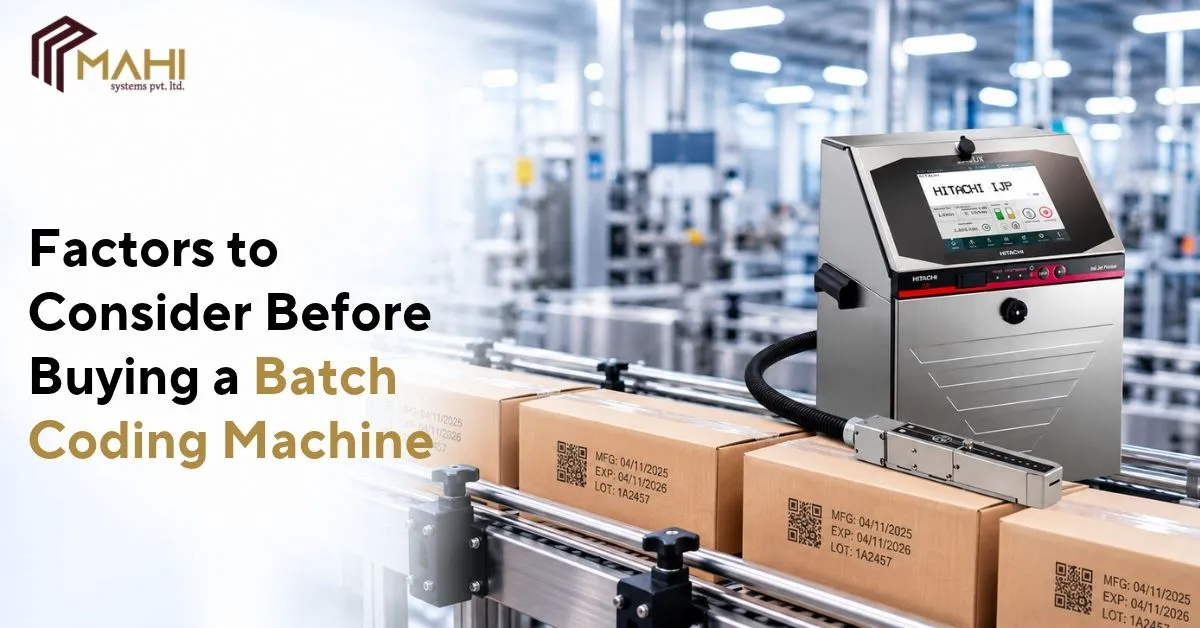
Choosing the right coding equipment is important for maintaining print quality, production efficiency, and consistent product identification. Manufacturers need to print batch numbers, manufacturing dates, expiry dates, MRP, barcodes, or QR codes on different products and packaging materials. Before investing in a Batch Coding Machine, businesses should evaluate their production requirements, printing technology, operating costs, and compatibility with existing equipment.
1. Packaging Material and Printing Surface
The printing surface is one of the first factors to consider. Plastic bottles, cartons, flexible films, metal components, cables, and corrugated boxes may require different coding technologies. A printer suitable for one material may not deliver the same results on another.
Check substrate compatibility and ensure the selected Batch Coding Machine can produce readable markings on your actual packaging material.
2. Choose the Right Printing Technology
Different coding technologies serve different applications. Understanding their working methods helps narrow down suitable options.
- Continuous Inkjet (CIJ) Printer: Suitable for non-contact coding on moving products, including compatible bottles, cables, and pipes.
- Thermal Inkjet (TIJ) Printer: Useful for printing clear text and codes on compatible packaging materials.
- Thermal Transfer Overprinter (TTO): Designed for variable-data printing on suitable flexible films and labels.
- Large Character Inkjet Printer: Used for prominent codes and identification details on secondary packaging.
- Piezo Inkjet Printer: Suitable for applications supported by its ink system and substrate compatibility.
- Fiber Laser Marking Machine: Used to create marks on compatible materials without conventional ink-based printing.
The best Batch Coding Machine depends on your product, printing requirements, and production environment, not simply the technology’s popularity.
3. Production Speed and Printing Requirements
The printer must keep pace with your production line. Consider conveyor speed, printing frequency, the amount of information required, and the number of products coded per minute. Also check whether you need simple dates and batch numbers or more detailed information, such as serial numbers and machine-readable codes.
A Batch Coding Machine that matches your production requirements can help maintain consistent coding without unnecessarily slowing operations.
Need help selecting coding equipment? Contact us to discuss your printing requirements and suitable solutions.
4. Print Quality and Code Readability
Printed information must remain clear enough for product identification and, where applicable, barcode or QR code scanning. When evaluating a Batch Coding Machine, consider character size, print placement, resolution, and the contrast between the printed information and the surface.
Request a sample print on your actual packaging material before finalising the purchase. This helps you evaluate whether the proposed solution meets your requirements.
5. Compare Purchase Price and Operating Costs
The initial purchase price does not represent the entire cost of ownership. Depending on the technology, expenses may include ink, ribbons, cleaning materials, replacement parts, maintenance, and servicing.
Compare these recurring costs alongside the machine’s capabilities. A Batch Coding Machine should fit your budget while meeting the practical demands of daily production.
6. Consider Integration and Technical Support
Check whether the printer can work with your existing conveyors, sensors, and packaging equipment. When selecting a Batch Coding Machine, consider message setup, operator training, troubleshooting assistance, and access to consumables.
Reliable technical support can help businesses address printing issues and maintain smoother production operations over time.
Frequently Asked Questions
Evaluate packaging material, printing technology, production speed, code requirements, running costs, and compatibility with existing equipment.
The best option depends on the material and application. CIJ, TIJ, and TTO printers serve different packaging requirements, while large character inkjet and laser systems suit other marking applications.
Yes, suitable machines can print expiry dates, manufacturing dates, batch numbers, barcodes, and QR codes, depending on their capabilities.
Yes. Compare consumables, routine servicing, cleaning, replacement parts, and technical support to understand the equipment’s ongoing costs.
Match the printer’s technology, printing speed, and code capabilities to your packaging material, production volume, and identification requirements.
Conclusion
Buying the right coding equipment requires evaluating packaging compatibility, printing technology, production speed, code quality, and ongoing costs. Comparing these factors helps manufacturers select a Batch Coding Machine that meets their operational needs and supports consistent product identification.
Related Posts